- Vintage
- 2025
- Region
- Navarre / Spain
- Grape
- Garnacha
- Type
- rose
- ABV
- 13.5%
- Volume
- 75cl
- Aging
- With Ageing
- Production
- Traditional
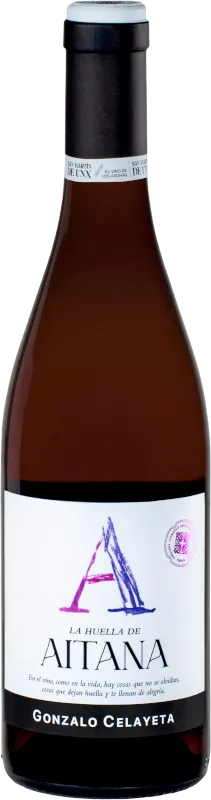
La Huella de Aitana · 2025
La Huella de Aitana is a special wine for Gonzalo Celayeta, it is ‘the spoilt child’. His first vintage was in 2011, the first year of Aitana's (eldest daughter) life, so he decided to dedicate a wine to her. It had to be something delicate, subtle, with ‘grace’... and what better than a rosé, a different rosé, with character and that would allow a good evolution in the bottle.
Raspberry pink, Violet glints
Highly aromatic, Complex, Toasty notes, Spices, Fruity
Powerful, Enveloping, Structured, Rich, Fresh, Balanced
Pasta, Rice dishes, Vegetables
Serve between 6ºC and 8ºC
About the vineyard[+]
Navarre: Crossroads of Cultures and Winemaking Navarre's winemaking heritage is as old as the very mountains that adorn its landscape. Located in the north of Spain, Navarre has historically been a land of encounters between different cultures, and this is reflected in the rich diversity of its wines. If you are looking to experience the magic of Navarrese wine, you are in the right place. During the Roman Empire vine cultivation was widespread throughout this region, but it was especially during the Middle Ages, as Navarre became a powerful kingdom in its own right, that its wines became more famous. Pilgrims, passing through the area on their Way to Santiago, tasted the wine and, recording comments in their diaries, described it as "excellent". Rosés of Legend If there is one thing that has established Navarre on the world wine map, it is its rosés. These wines, with their vibrant hues and fresh character, are the perfect expression of Navarrese wine. Native and Foreign Grapes Navarre has traditionally been known as Spain's great rosé wine producer, but nowadays the situation has changed with a gradual tendency to move over to the production of quality red wines. Although historically the Garnacha has been the most popular variety, over recent years, particularly in its southern zone the Tempranillo grape has been planted and now exceeds the surface area of Garnacha. Other grapes chosen for planting that are giving highly satisfactory results are Cabernet Sauvignon, Merlot and Chardonnay. A Terroir of Contrasts From the Atlantic influence of the north to the more arid climate of the south, Navarra offers a range of microclimates that result in wines of unparalleled complexity. From north to south, Navarre could be described as resembling a small country: the Pyrenees form a border with France to the north, while in the central part, the slightly undulating ground supports cereal fields, market garden produce and vineyards, and to the south, there is a vast semi-arid area through which the River Ebro flows. This means that the DO is divided into 5 sub-regions lying to the south of Pamplona, although they generally share a continental climate (with an Atlantic influence in the northern sub-zones) and brownish-grey limestone soils that are poor in organic matter. These are the sub-regions: Valdizarbe, Tierra Estella, Baja Montaña, Ribera Alta and Ribera Baja. Our Navarrese Wine Curation We work side by side with family-owned wineries, cooperatives and cutting-edge producers in Navarra to bring you a selection that embodies the essence and diversity of this very special region. Each bottle is a direct passport to the vineyards of Navarre.