- Vintage
- NV
- Region
- Champagne AOC / France
- Grape
- Pinot Meunier, Pinot Noir, Chardonnay
- Type
- sparkling
- ABV
- 12.5%
- Volume
- 75cl
- Aging
- Reserva
- Production
- Traditional
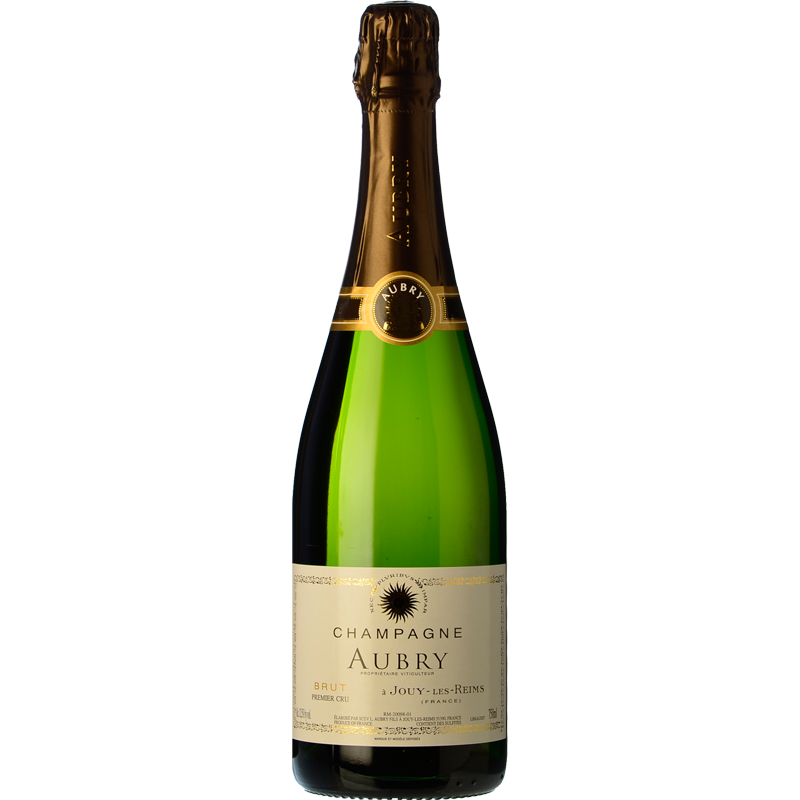
Aubry Premier Cru Brut
The non-vintage Aubry Premier Cru Brut is a perfect gateway to the wines of one of Champagne's most fascinating producers. The sparkling wines produced by the Aubry brothers are very expressive and individual, and continue to amaze and delight all who taste them year after year. This Premier Cru is a classic Champagne made from grapes of the three historic varieties (with the clear predomination of Meunier, at 60%) and a small contribution from traditional grapes such as the Arbanne, the Petit Meslier and the Fromenteau. Approximately half the wine dates back to a 1998 perpetual reserve, a key factor in understanding the origin of its complexity. The first fermentation takes place in stainless steel tanks and a malolactic is usually favoured in order to mellow the acidity and allow the use of very small amounts of liqueur d'expedition (6 gr./l), thus highlighting the grape's natural freshness. After the second fermentation, the wine matures for between 18 and 24 months on its lees in the bottle, gaining in complexity and becoming more refined as time works its magic. On uncorking a bottle of Aubry Premier Cru Brut, a string of fine bubbles preempts a fresh nose predominately revealing aromas of strawberries, pear and peach, with touches of dried fruits and nuts, cereals and spices. On the palate, the roundness of the Meunier encases a delicate structure and considerable character, exhibiting all the house's finesse and personality. Suggestions of rose petals and mint can be discerned as well as a saline hint. Its subtle finish, long and fresh, invitingly prompts another sip. Fantastic when paired with any kind of aperitif or starter.
Raspberry, Pear, Peach, Dried fruit and nuts, Spices
Refreshing acidity, White fruit, Ripe fruit, Saline
Aperitifs, Starters, Scallops, Canapés, Smoked fish
Serve between 6ºC and 8ºC
About the vineyard[+]
Champagne is the name of the most glamorous sparkling wine globally and the name of the region in France where it is produced. Champagne is synonymous with celebration, history and tradition, but not all sparkling wines can be called Champagne, not even French; only those made east of Paris enjoy this privilege. In our shop, you can find the best selection of French Champagne at the best price. History There is sufficient evidence to show that vines have been grown in Champagne since the 4th century. From the 7th century, the region specialised in producing and selling light red wines that catered to consumers in the vicinity of the capital. During the winter, temperatures dropped, and fermentation stopped, so winemakers hurried to bottle their wines. However, when temperatures rose in spring, fermentations were reactivated inside the bottles, generating a carbon dioxide gas that winemakers didn't fully understand. It also took them plenty of time to learn to control it. What was initially a problem became a fashion that by the mid-17th century had reached the British Isles. The most widespread theory about the inventor of Champagne is that of Dom Perignon, a Benedictine monk from the Abbey of Hautvillers. However, it seems to be more myth than reality. New theories postulate that the origin of the most famous sparkling wine on the planet could be found in England, back in 1660. A document in the Royal Society of London written by Sir Christopher Merrett in 1662, several years before Dom Perignon produced his famous Champagne, explains how English winemakers added sugar and molasses to wine to make it sparkling. Dom Perignon would perfect the method decades later, making the first blanc de noirs and blending wines from different vineyards to find the perfect balance. However, he failed to avoid the at that time undesirable bubbles that the English market curiously loved; thicker glass was the solution to prevent the refermentations from shattering more bottles. Dom Pérignon died in 1715, but before saying goodbye, he created the basic principles of the technique of secondary fermentation in the bottle or méthode champenoise. The méthode champenoise or traditional method The méthode traditionelle is the highest quality system for the production of sparkling wines as it allows the best control over the entire process, from fermentation to bottling. Once the grapes have been harvested and transported to the winery, they are gently pressed to obtain a must of the highest quality and delicacy. Afterwards, the musts of the different varieties, rich in acids and high sugar content, ferment separately in containers of materials such as stainless steel, wood, etc., depending on each winery. After completing this process, the technicians determine the proportion of each wine (grape, vintage, plot, barrel, etc.) that will make up the final blend of the base wine, an essential process known as blending. The bottles are then filled with it and with a mixture of sugar and yeast (known as liqueur de tirage), which will be responsible for the second fermentation in the bottle, giving rise to the essential mousse. Afterwards, the bottles (most of them) are closed with a cap. The bottles are placed horizontally in dark, damp and cool places where they will rest for at least 15 months for the non-vintage champagnes (with a blend of vintages) and 3 years for the Millésimes (vintage champagnes). During that time, the wines refine and acquire aromas of bread and yeast, thanks to the inactive yeasts still resting inside. Once the ageing process is over, it is time to remove the lees. To do so, the bottles are placed on pupitres (triangular wooden structures with round holes for the neck of the bottles) and are rotated and tilted daily, until they are vertical and with all the lees in the neck after a few weeks. Instead of doing it manually, many wineries now use gyropalettes, computer-controlled structures that drastically reduce the effort dedicated to remuage. Then comes disgorging, the moment of uncorking the bottle so that the carbon dioxide itself can expel all the remains of fermentation; this process is often carried out by freezing the neck of the bottles to encourage the expulsion of the sediment. Before corking the bottles, they are refilled to their final volume with the same wine. To obtain a sweeter Champagne, they are refilled with a mixture of wine and sugar known as liqueur d'expedition. A capsule and muzzle are also added to the cap to contain the pressure safely. Basic vocabulary - Brut: the most common style of Champagne, with a small amount of sugar added (less than 12 grams per litre). - Non-Vintage (NV): Champagne made from a blend of different vintages. - Millésime: Champagne that comes from a blend of wines from the same year only in the best vintages. - Blanc de Blancs: a white wine made from white grapes, i.e. single varietal Chardonnay. - Blanc de Noirs: white wine made from red grapes, Pinot Noir and meunier. - Rosé: rosé champagne, obtained by blending red and white wines or macerating red grapes with their must. - Cuvée Prestige: these are the highest quality wines of the wineries, the ones with the most extended ageing and usually the highest priced. They are made with grapes from the best plots of each property. The vineyard and its regions The AOC Champagne is located in the northeast of France, and its northern border is within the limits of the areas considered suitable for wine production. It covers 150 kilometres from north to south and 115 kilometres from east to west. Its appellation includes 17 grand crus, 47 premiers crus and 32,000 hectares of vineyards. In the latitudes where the Champagne vineyards grow, ripening is difficult, so the aim is to lengthen the grapes' ripening cycle as much as possible. For that reason, many of the best vineyards are on the hillsides and valley slopes, where they can be sheltered from the winds and enjoy better exposure to the sun. The landscape of Champagne is that of a plain (between 60 and 360 metres above sea level) crossed by several rivers and covered with white limestone soils that cast the sun on the plants. The subsoils are calcareous and porous and drain well while retaining sufficient water. Spring frosts are one of the most significant risks for the region, in some dramatic cases wiping out almost the entire crop. The Champenoise vineyard is divided into 5 zones: Montagne de Reims, Vallée de Marne, Côte des Blancs, Côte de Sézanne and Côte de Bar. The first 3, located around Reims and Épernay, are the most prestigious, while Sézanne and Bar hide great wines worth discovering. The Montagne de Reims is the fiefdom of some of the best Pinot Noir vineyards, in fact, 9 of the 17 grand crus are located here, examples of maisons located here would be: André Clouet, Dumenil, Krug o Billecart-Salmon, Taittinger, Bollinger or Bruno Michel. The Côte des Blancs is a land of craie (chalk) and Chardonnay, with soils of intense minerality and white grapes where we can enjoy champagnes from houses such as Perrier-Jouët, Delamotte or Pierre Moncuit. The Côte de Sézanne sits on a clay-limestone subsoil, which, together with its SE orientation, allows the production of fruity wines. Much further south, closer to the Chablis vineyard, is the Côte de Bar, a sub-region that accounts for one-fifth of the total vineyard in Champagne and produces half of all Pinot Noir. Grapes Champagne is basically made from 3 different grape varieties, a white one (Chardonnay) and two reds (Pinot Noir and Pinot Meunier). The first brings freshness and structure to the wine, while the Pinot Noir gives it depth, perfume and elegant fruit; the Meunier, somewhat more rustic, adds richness and wild fruit to the blend. Chardonnay occupies 28% of the vineyard, and its wines tend to emanate floral, citrus and mineral aromas, with elegance as a common denominator. They evolve slowly, so the best Blanc de Blancs can be cellared for years. Pinot Noir covers 39% of the vineyard and grows particularly well on chalky soils; its typical aromas are of red fruits, and its wines tend to have an intense character. Meunier, which covers 33% of the vineyard, grows very well on clay soils and can withstand extreme conditions. Its wines are somewhat lighter and evolve more quickly, but, on the other hand, they round off many blends. A tiny percentage of the vineyard, barely 0.3%, is planted with four varieties that many would not place in Champagne: Arbanne, Petit Meslier, Pinot Blanc and Pinot Gris (or Fromenteau). Despite a popular belief that their planting is forbidden, this is not the case. Three hundred years ago, Fromenteau covered half of the Champenoise vineyard, but when producers began to notice the quality of the wines of neighbouring Burgundy, they decided to replant their vineyards with Pinot Noir and Chardonnay. The four original grapes still add a touch of tradition to some blends today and are even exceptionally produced as single varietals.